
A strong economy is not built only through investment, technology, natural resources, or entrepreneurship. Behind every successful economic system is a legal framework that creates order, protects rights, encourages fair competition, and gives individuals and businesses the confidence to participate in economic activities. This is why the role of law in building a strong and fair economy is so important.
Laws establish the rules under which businesses operate, workers are employed, contracts are enforced, taxes are collected, and consumers are protected. Without effective laws, economic activity can become unpredictable. Businesses may hesitate to invest, workers may face exploitation, consumers may lose confidence, and unfair market practices can become common.
A fair legal system does more than punish wrongdoing. It creates an environment where economic opportunities can grow while protecting society from fraud, corruption, discrimination, and abuse of market power. When laws are transparent, consistently applied, and supported by effective institutions, they can contribute significantly to long-term economic stability.
Understanding the Relationship Between Law and the Economy
Law and economics are closely connected. Almost every important economic transaction operates within a legal framework. Buying property, starting a company, hiring employees, borrowing money, investing capital, importing products, and signing business agreements all involve legal rights and responsibilities.
The law defines what individuals and organizations can own, what agreements they can make, and what remedies are available when someone violates those agreements.
For example, imagine a company supplying equipment to another business. Both parties sign a contract specifying the price, quantity, quality standards, and payment date. If there were no reliable system for enforcing that agreement, the supplier would face greater financial risk.
An effective legal system reduces this uncertainty. It provides procedures for resolving disputes and encourages businesses to enter into transactions with greater confidence.
Why the Rule of Law Matters for Economic Growth
The rule of law means that laws apply consistently and that individuals, companies, and public institutions are accountable under an established legal framework.
For economic development, predictability is particularly important. Investors generally want to understand the rules governing taxation, property, contracts, employment, and business operations before committing capital.
If regulations change unpredictably or laws are enforced inconsistently, businesses may perceive greater risk. This can discourage long-term investment and make economic planning more difficult.
In contrast, a transparent legal environment helps businesses understand their responsibilities and make better-informed decisions.
Creating Economic Confidence
Confidence is one of the foundations of economic activity. A person purchasing a house expects legal recognition of ownership. A bank providing financing expects repayment agreements to be enforceable. An employee expects wages and employment conditions to follow applicable regulations.
When people trust institutions and legal processes, they are generally more willing to participate in formal economic activities.
This confidence supports investment, employment, lending, trade, and entrepreneurship.
Protecting Property Rights
Property rights are an essential part of a functioning market economy. Laws determine how individuals and businesses can own, use, transfer, lease, or sell assets.
Property can include land, buildings, vehicles, machinery, financial assets, inventions, trademarks, and other forms of intellectual property.
Clear ownership rights allow people and businesses to make long-term plans. A company is more likely to invest in a factory, for example, when it has confidence that its legal ownership or lease rights will be recognized.
Intellectual Property and Innovation
Modern economies increasingly depend on knowledge, technology, software, creative work, and innovation. Intellectual property laws can protect certain inventions, brands, designs, and creative works.
These protections can encourage businesses and individuals to invest time and resources in developing new products and ideas.
However, intellectual property systems must also seek an appropriate balance. Excessively restrictive rules can sometimes limit competition or access, while insufficient protection may reduce incentives for innovation.
A well-designed legal framework therefore aims to protect legitimate rights while supporting broader economic development.
Contract Law and Business Stability
Contracts are fundamental to business.
Companies use contracts when purchasing goods, providing services, employing workers, renting property, obtaining financing, forming partnerships, and completing many other transactions.
Contract law establishes the conditions under which agreements are recognized and provides mechanisms for addressing breaches.
Consider a manufacturer that orders raw materials from a supplier. The manufacturer needs those materials by a particular date to maintain production. A written agreement can establish delivery requirements, pricing, payment terms, and responsibilities if either party fails to meet its obligations.
Effective contract enforcement reduces uncertainty and can lower the risks associated with doing business.
Supporting Small Businesses
Contract protection is particularly important for small and medium-sized enterprises.
Large organizations may have greater financial resources to absorb losses or handle lengthy disputes. Smaller businesses often have less flexibility.
Efficient legal procedures can help smaller firms protect their interests, recover legitimate debts, and resolve commercial disagreements without excessive costs or delays.
This contributes to a healthier business environment where opportunities are not limited only to the largest companies.
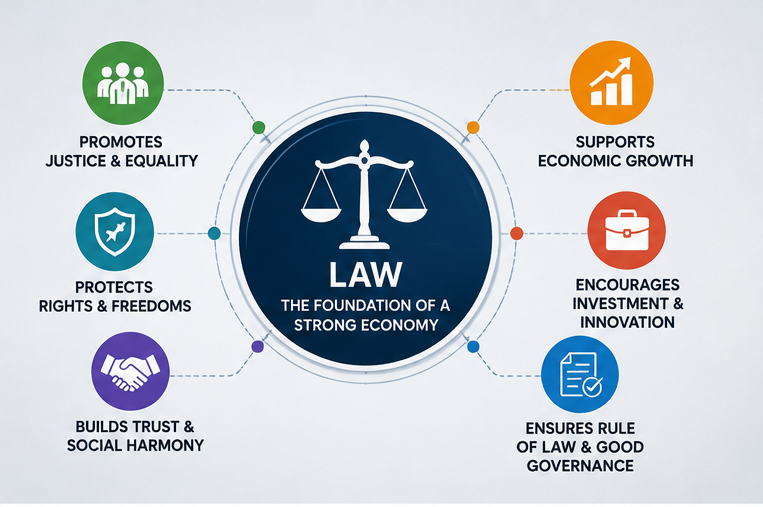
Law Promotes Fair Competition
Competition encourages businesses to improve quality, control prices, innovate, and respond to consumer needs. However, markets do not always remain competitive without appropriate rules.
Dominant companies may attempt to restrict competition, coordinate prices, create unfair barriers to entry, or misuse market power.
Competition and antitrust laws are designed to address such practices.
A fair competitive environment gives businesses an opportunity to succeed based on factors such as efficiency, innovation, service, and product quality rather than manipulation or unlawful conduct.
Preventing Monopolistic Practices
A monopoly or highly concentrated market is not automatically unlawful in every legal system. The concern often arises when market power is abused.
Competition laws may address practices such as price fixing, bid rigging, certain anti-competitive agreements, or conduct intended to unfairly exclude competitors.
Effective enforcement can protect the competitive process and contribute to greater consumer choice.
Consumer Protection and Economic Trust
Consumers are central to economic activity. Businesses depend on people purchasing goods and services, but customers need confidence that products are reasonably safe and commercial claims are not deliberately misleading.
Consumer protection laws can establish standards concerning product safety, advertising, pricing information, warranties, financial services, and unfair commercial practices.
For example, if a company knowingly makes false claims about a product, consumer protection rules may provide regulators or customers with legal remedies.
Such protections strengthen trust between consumers and businesses.
Why Consumer Confidence Matters
When consumers repeatedly experience fraud or misleading business practices without meaningful protection, confidence can decline.
A reliable consumer protection framework makes legitimate businesses more attractive because customers know that certain minimum standards apply.
In this way, consumer law protects individuals while also supporting responsible businesses and healthier markets.
Employment Law and a Fair Economy
Economic growth is not only about increasing corporate profits. A strong economy also depends on productive workers and sustainable employment relationships.
Employment laws can establish rules regarding wages, working hours, workplace safety, contracts, discrimination, leave, termination, and other employment matters.
The specific protections differ between countries, but their broader purpose is often to establish minimum standards and define the rights and responsibilities of employers and employees.
Balancing Workers’ and Employers’ Interests
Good employment regulation requires balance.
Rules that provide inadequate worker protection may contribute to exploitation and unsafe conditions. On the other hand, unnecessarily complex or inefficient regulation can create additional burdens for businesses and discourage formal employment.
Well-designed laws seek to protect basic rights while allowing businesses sufficient flexibility to operate, invest, and create jobs.
Tax Law and Public Economic Development
Governments require revenue to provide public services and infrastructure. Tax laws establish how revenue is collected from individuals and businesses.
Tax revenue can support education, transportation, public safety, courts, healthcare systems, infrastructure, and other public services depending on a country’s policies and institutions.
These services can indirectly support economic growth.
For example, reliable transport infrastructure can reduce business logistics costs, while education can help create a more skilled workforce.
Importance of a Fair Tax System
A tax system should aim to be understandable, administratively workable, and consistently enforced.
Complex or unpredictable taxation can make financial planning difficult, particularly for smaller businesses.
At the same time, widespread tax evasion can reduce government revenue and place a greater burden on taxpayers who follow the rules.
Effective tax administration therefore plays an important role in maintaining both public finances and economic confidence.
Law Helps Reduce Corruption
Corruption can seriously damage an economy.
Bribery, misuse of public resources, favoritism, and conflicts of interest can distort competition and reduce public confidence in institutions.
Businesses may become reluctant to invest where success depends more on unofficial payments or political connections than on legitimate competition.
Anti-corruption laws, transparency requirements, independent oversight, and effective enforcement can reduce these risks.
However, simply having laws on paper is not enough. Institutions must have the capacity and independence necessary to apply those laws fairly.
Financial Laws Protect Economic Stability
Banks, investment firms, insurance companies, payment providers, and other financial institutions are important components of modern economies.
Financial regulation establishes standards intended to promote stability, transparency, responsible conduct, and protection against certain forms of financial abuse.
Banks, for example, operate under rules concerning capital, risk management, reporting, lending practices, and customer protection.
Without appropriate oversight, excessive risk-taking or fraudulent financial activity can cause losses that extend beyond individual companies.
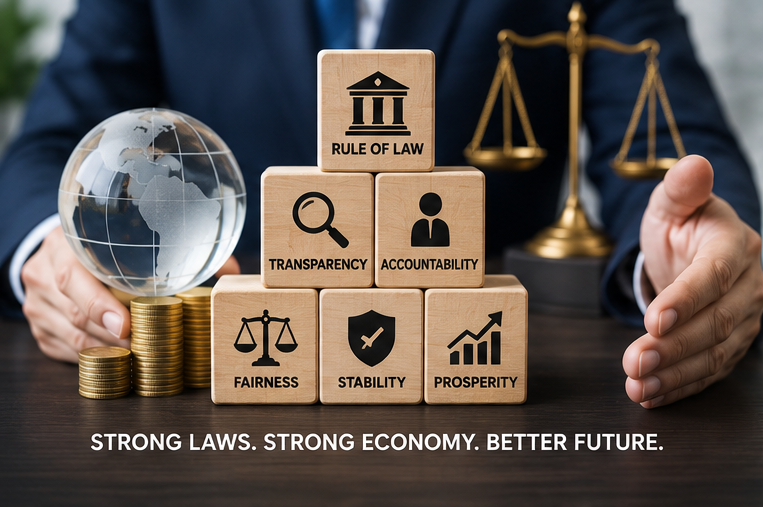
Preventing Financial Crime
Legal systems also address financial crimes such as fraud and money laundering.
Effective financial enforcement protects legitimate businesses and helps preserve confidence in banking and investment systems.
As financial services become increasingly digital, legal frameworks must also respond to new technologies and emerging risks.
Environmental Law and Sustainable Economic Growth
Economic growth can create environmental costs if businesses are allowed to pollute without limits or use natural resources irresponsibly.
Environmental laws establish standards concerning areas such as emissions, waste management, water quality, resource use, and environmental protection.
Some businesses initially view environmental regulation primarily as a cost. However, sustainable rules can encourage cleaner technology, energy efficiency, responsible resource management, and innovation.
Long-term economic strength depends on balancing present economic needs with the resources required by future generations.
Business Law Encourages Entrepreneurship
Entrepreneurs create businesses, introduce products, generate employment, and contribute to innovation.
A supportive legal system can make entrepreneurship easier by providing clear procedures for business registration, licensing, taxation, financing, bankruptcy, and dispute resolution.
If starting a legitimate business requires excessive bureaucracy, entrepreneurs may struggle to enter the formal economy.
Simpler and transparent regulations can lower barriers while maintaining necessary protections.
Bankruptcy Laws and Second Chances
Business failure is a normal risk of entrepreneurship.
Effective insolvency and bankruptcy laws can establish an orderly process for dealing with debt when a business cannot meet its obligations.
These systems can protect creditors while giving honest entrepreneurs a structured way to address financial failure.
A balanced insolvency framework can encourage responsible risk-taking because failure does not necessarily mean permanent economic exclusion.
Equal Access to Economic Opportunity
A fair economy should provide people with meaningful opportunities to participate regardless of irrelevant personal characteristics.
Legal protections against unlawful discrimination can contribute to fairer access to employment, education, housing, finance, and business opportunities.
Fairness does not necessarily mean that everyone receives identical economic outcomes. Instead, it means that economic participation should operate under transparent rules and that people should have access to legal remedies when their rights are violated.
This can help economies use a broader range of skills, ideas, and talent.
Challenges in Using Law to Strengthen the Economy
Laws can support economic development, but poorly designed regulation can also create problems.
Excessive bureaucracy may increase business costs. Complicated licensing requirements can discourage new companies. Slow courts can make contract enforcement expensive. Unclear regulations can create uncertainty.
Another major challenge is enforcement.
A country may have strong laws on paper, but those laws have limited value if institutions cannot enforce them effectively.
Finding the Right Regulatory Balance
The goal should not simply be to create more laws.
The objective is to develop effective, understandable, proportionate, and enforceable laws.
Policymakers should regularly review regulations and consider whether they still address current economic conditions.
Consultation with businesses, workers, consumers, legal experts, and other stakeholders can also help governments understand the practical effects of proposed rules.
Technology Is Changing Economic Law
Digital transformation is creating new legal challenges.
Artificial intelligence, digital payments, online marketplaces, cryptocurrencies, remote work, cloud computing, and data-driven businesses have changed the way economic activity takes place.
Traditional laws may not always address these developments effectively.
Governments and regulators are therefore considering new approaches to areas such as data protection, cybersecurity, digital competition, AI governance, online consumer protection, and financial technology.
The challenge is to protect society without unnecessarily limiting beneficial innovation.
The Future Role of Law in Economic Development
As economies become more connected and technology-driven, law will remain an important foundation of economic development.
Future legal systems will need to respond to rapid technological change, cross-border digital trade, climate risks, changing employment models, and new financial technologies.
Countries that maintain transparent, efficient, and adaptable legal institutions may be better positioned to attract investment and support entrepreneurship.
At the same time, economic growth should be accompanied by fairness, accountability, and protection of legitimate rights.
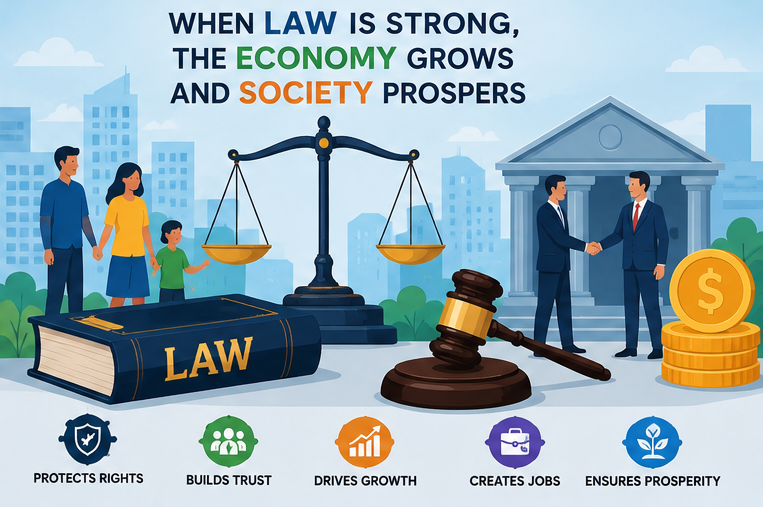
Conclusion
The role of law in building a strong and fair economy extends into almost every part of economic life. Law protects property, supports contracts, regulates financial markets, promotes competition, protects consumers and workers, provides frameworks for taxation, and helps combat corruption.
However, economic success does not depend simply on having a large number of laws. What matters is the quality of those laws, how clearly they are written, how fairly they are applied, and how effectively institutions enforce them.
A balanced legal framework creates confidence for investors and businesses while protecting individuals and society from unfair practices. When law supports transparency, competition, innovation, accountability, and equal treatment, it becomes more than a regulatory system—it becomes one of the foundations of sustainable economic prosperity.


